
The Emerging Al-Shabaab–Houthi Alleged Alliance: Implications for Maritime Security and Kenya’s National Security
Date: 9 October 2026
By Mohamed Abdi
Founder and Researcher, Foxnile Consulting Group Inc.
Introduction
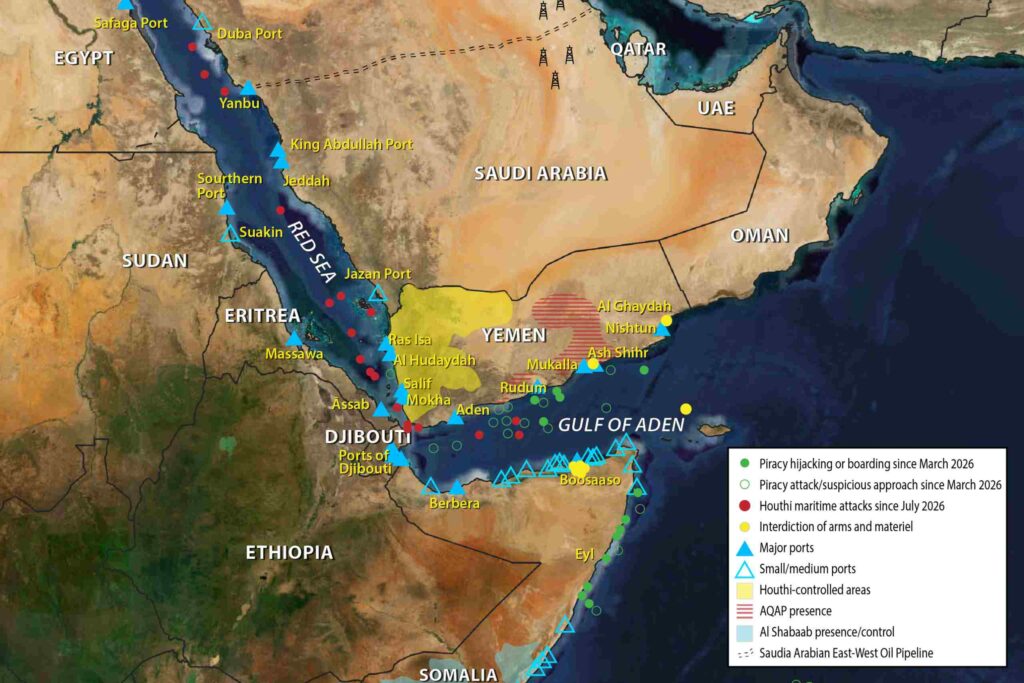
The growing security concerns surrounding the alleged relationship between Somalia-based Al-Shabaab and Yemen’s Houthi movement highlight an evolving threat landscape across the Gulf of Aden, the Red Sea and the wider East African region. Separated by the narrow maritime corridor between Somalia and Yemen, the two groups operate within a region characterized by longstanding smuggling networks, armed conflict and strategic international shipping routes.
What may have begun as opportunistic weapons trafficking and informal criminal interactions has raised concerns about the possibility of more structured cooperation involving weapons, military technology, training and maritime logistics. However, the nature and extent of any operational relationship remain matters requiring careful verification.
If substantiated, deeper cooperation between the two groups could have consequences extending beyond Somalia and Yemen. It could affect maritime security, regional counterterrorism efforts, international trade and the security interests of countries such as Kenya and Saudi Arabia.
The central concern is not simply whether the groups share ideological opposition to Western interests, but whether their interactions could translate into practical capabilities that increase the threat to regional stability.
1. Weapons, Technology and Military Training
One of the most significant concerns surrounding the alleged relationship is the potential transfer of weapons and military technology between Houthi-linked networks and Al-Shabaab.
Reports of possible interactions have raised questions about whether Al-Shabaab could gain access to more sophisticated capabilities, including drones, explosive technologies, surveillance equipment and improved reconnaissance methods. There are also concerns about possible military or ideological training involving members of the group in Houthi-controlled areas.
These allegations should be distinguished from independently verified evidence of systematic cooperation. Nevertheless, they warrant attention because access to advanced equipment, technical knowledge and external support could change the operational environment in which Al-Shabaab functions.
The proliferation of relatively accessible drone technology has already complicated security operations in several conflict zones. If Al-Shabaab were to acquire additional technical expertise or equipment through external networks, the group could potentially expand its surveillance capabilities and increase the sophistication of certain attacks.
Such developments would also complicate counterterrorism operations by requiring security agencies to adapt their intelligence collection, threat assessment and defensive capabilities.
The strategic concern, therefore, extends beyond conventional weapons smuggling. It involves the possibility that transnational networks could help armed groups acquire capabilities that would otherwise be difficult or costly to develop independently.
2. Maritime Security and the Gulf of Aden
The Gulf of Aden is one of the world’s strategically important maritime corridors, linking the Indian Ocean with the Red Sea and the Suez Canal. Commercial shipping moving through this route supports international trade, energy transportation and supply chains connecting Asia, Europe, the Middle East and Africa.
Any expansion of militant activity or weapons trafficking in this environment could have consequences well beyond the immediate conflict zones.
Al-Shabaab has operated within Somalia’s wider illicit economy, while the Houthi movement has demonstrated its capacity to threaten commercial shipping in the Red Sea region. The possibility that networks associated with these groups could develop closer connections has consequently attracted security attention.
If such cooperation were established, existing criminal networks could potentially facilitate the movement of illicit goods, personnel and financial resources across maritime and land-based routes. At the same time, closer operational links could create additional risks for commercial shipping and regional maritime infrastructure.
However, the existence of parallel smuggling networks or similar adversaries does not, by itself, establish a coordinated operational alliance. Investigators must distinguish between direct cooperation, indirect logistical connections and independent activities that happen to overlap.
This distinction is essential for maritime-security planning. Governments and international partners need reliable intelligence to identify actual relationships, understand their significance and direct resources towards the most credible threats.
The broader challenge is that terrorism, arms trafficking, piracy and organized crime can intersect within the same maritime environment. Addressing these threats requires coordinated intelligence and law-enforcement responses rather than treating each category as an entirely separate problem.
3. Implications for Saudi Arabia and the International Community
The potential convergence of Houthi-linked networks and Al-Shabaab raises concerns for countries across the Middle East, particularly Saudi Arabia, whose security and economic interests are closely connected to the Red Sea and the wider Gulf region.
Saudi Arabia has faced Houthi attacks targeting critical infrastructure and other strategic interests. The wider Red Sea security environment has also demonstrated how regional conflicts can disrupt international shipping, increase transportation costs and threaten the reliability of global supply chains.
The possibility of stronger connections between Houthi-linked networks and Al-Shabaab would add another dimension to these existing concerns. If weapons, technology, personnel or financing were to move through interconnected networks, the resulting security challenges could extend across the Middle East and East Africa.
For Saudi Arabia, protecting critical infrastructure and maritime interests requires sustained cooperation with regional and international partners. For countries bordering the Red Sea and Gulf of Aden, the priority is to prevent insecurity from spreading across maritime boundaries and into neighbouring states.
The international community should therefore strengthen cooperation with Saudi Arabia and other regional partners in addressing verified threats to maritime security, countering illicit arms transfers and improving intelligence coordination.
Such cooperation should be grounded in credible evidence, respect for international law and a shared commitment to protecting civilian populations, commercial shipping and critical infrastructure.
Ultimately, maritime security cannot be separated from the wider regional security environment. Developments in Yemen, Somalia and the surrounding waters must be assessed as interconnected elements of a broader strategic challenge.
4. Why Kenya Should Be Concerned
Kenya has a direct interest in developments across the Gulf of Aden and the Red Sea, even though it is not a direct party to the Saudi–Houthi conflict.
The country’s geographical position, extensive Indian Ocean coastline, shared border with Somalia and dependence on international maritime trade place it within an interconnected regional security environment.
Any deterioration in maritime security could affect Kenya through two principal channels: economic disruption and an increased terrorist threat.
The economic implications of maritime insecurity
Kenya relies on maritime transportation for a substantial proportion of its international trade. Disruptions along important shipping routes can increase the cost and complexity of moving goods, even when Kenyan territorial waters remain unaffected.
If insecurity in the Gulf of Aden or Red Sea leads shipping companies to reroute vessels, businesses may face higher freight charges, increased fuel costs, longer delivery times and higher insurance premiums.
These additional costs can affect importers, exporters, manufacturers, retailers and consumers. Businesses dependent on imported raw materials, machinery, fuel and other essential goods may experience increased operating expenses, while exporters could face delays and reduced competitiveness.
The effects may also extend to the wider East African region, given the role of Kenya’s transport and logistics infrastructure in regional commerce.
For this reason, maritime insecurity should not be viewed exclusively as a naval or counterterrorism concern. It is also an economic resilience issue that requires cooperation between security agencies, port authorities, shipping operators and the private sector.
The potential terrorist threat to Kenya
A second concern is the possibility that improved access to weapons, technology or external logistical support could increase Al-Shabaab’s operational capabilities.
Kenya has experienced repeated attacks attributed to Al-Shabaab and remains exposed to threats associated with instability in neighbouring Somalia. Any independently verified improvement in the group’s capabilities would therefore be significant for national security planning.
Potential access to more sophisticated surveillance equipment, explosive technologies or drone capabilities could require adjustments to existing security arrangements. However, the extent of any such change would depend on the nature of the technology acquired, the group’s ability to use it effectively and the preparedness of Kenyan security agencies.
Connections between militant organizations and criminal networks would present an additional challenge. Illicit networks can facilitate the movement of goods and money, while providing opportunities for concealment and evasion of law enforcement.
The convergence of terrorism and organized crime can make it more difficult to identify the individuals, transactions and movements that connect seemingly unrelated incidents.
Kenya should therefore prioritize the identification of credible networks and emerging threat indicators rather than assume that an alleged regional alliance automatically translates into a specific operational threat within its borders.
5. Strengthening Kenya’s Preventive Response
Kenya should adopt a preventive, intelligence-led approach to emerging threats across the Gulf of Aden and the wider East African region. Three areas deserve particular attention.
5.1 Strengthen regional intelligence sharing
Kenya should strengthen intelligence-sharing arrangements with Somalia, relevant regional security partners, the Intergovernmental Authority on Development (IGAD) and international maritime-security organizations.
Timely information exchange can help authorities identify suspicious maritime activity, illicit arms transfers, cross-border movements and emerging criminal networks.
Particular emphasis should be placed on connecting information collected by maritime authorities with intelligence held by land-based security agencies. This would help investigators identify broader patterns that might otherwise be missed when individual incidents are examined in isolation.
Cooperation should also include appropriate information-sharing protocols, clear responsibilities and safeguards to protect sensitive information and prevent the misuse of intelligence.
5.2 Enhance border surveillance and intelligence capabilities
Kenya should continue strengthening border-security capabilities along the Kenya–Somalia frontier, particularly in Mandera, Wajir, Garissa and Lamu.
Effective border security requires more than increasing personnel numbers. It depends on the ability to identify credible threats, understand changing patterns of illicit activity and coordinate responses across relevant agencies.
A balanced approach should combine intelligence analysis, appropriate surveillance technologies, lawful border controls and cooperation with communities living in border areas.
Security agencies should also improve coordination between national and county-level authorities where appropriate, ensuring that relevant information reaches the institutions best placed to assess and respond to it.
These measures should be designed to protect communities and legitimate cross-border economic activity while disrupting criminal and terrorist networks.
5.3 Integrate coastal communities into maritime early warning
Coastal communities can play an important role in strengthening Kenya’s maritime-security framework.
Fishermen, boat operators, traders, transport providers and other people working along the coast often possess detailed knowledge of local maritime activity. Their observations can complement information obtained through formal surveillance and other security systems.
In areas such as Lamu, authorities should consider strengthening confidential reporting channels, building trusted relationships with community representatives and improving communication between residents and relevant security agencies.
Such initiatives must be supported by clear procedures for assessing reports, protecting the identities of informants where appropriate and preventing false allegations from resulting in unjustified action.
Community participation is most effective when residents trust the institutions receiving their information. Indiscriminate security operations, collective punishment and profiling risk undermining that trust.
An inclusive approach would enable local knowledge to contribute to early warning while protecting legitimate livelihoods and respecting the rights of coastal populations.
6. A Broader Regional Maritime-Security Strategy
In addition to these three priorities, Kenya and its regional partners should view maritime security as a shared responsibility that extends beyond national borders.
Cooperation between maritime authorities, port operators, shipping companies, financial investigators and counterterrorism agencies can help identify threats that cross institutional boundaries.
Regional governments should also strengthen lawful mechanisms for monitoring illicit financial flows, investigating arms-trafficking networks and protecting critical transport infrastructure.
At the international level, cooperation should focus on evidence-based threat assessments, the exchange of relevant intelligence and coordinated responses to verified security incidents.
Equally important is the need to distinguish confirmed facts from emerging allegations. Overstating the strength of a relationship between armed groups can undermine public confidence, distort policy priorities and divert resources from established threats.
A credible regional strategy must therefore combine vigilance with analytical discipline. It should prepare for plausible scenarios without presenting unverified developments as established facts.
Conclusion
The alleged relationship between Al-Shabaab and the Houthi movement raises important questions about the future of maritime security across the Gulf of Aden, the Red Sea and the wider East African region.
If closer operational cooperation is substantiated, it could create additional challenges involving weapons proliferation, military technology, illicit networks and regional counterterrorism efforts. The consequences could extend to Saudi Arabia, Kenya and the international community through both direct security threats and disruptions to commercial shipping.
For Kenya, the stakes are particularly significant. Its proximity to Somalia, exposure to Al-Shabaab-related threats and dependence on maritime commerce make regional developments an important consideration in national security and economic planning.
Strengthening intelligence cooperation, improving border and maritime awareness, and incorporating coastal communities into early-warning systems would help Kenya improve its capacity to anticipate and respond to emerging threats.
Above all, an effective response must be preventive, coordinated and evidence-based. By strengthening regional partnerships and distinguishing verified intelligence from unconfirmed allegations, Kenya and its partners can better protect national interests, preserve maritime trade and contribute to stability across the Middle East and East Africa.